



















Indian Prime Minister Highlights Nation’s Diversity in Address to Ghana’s Parliament
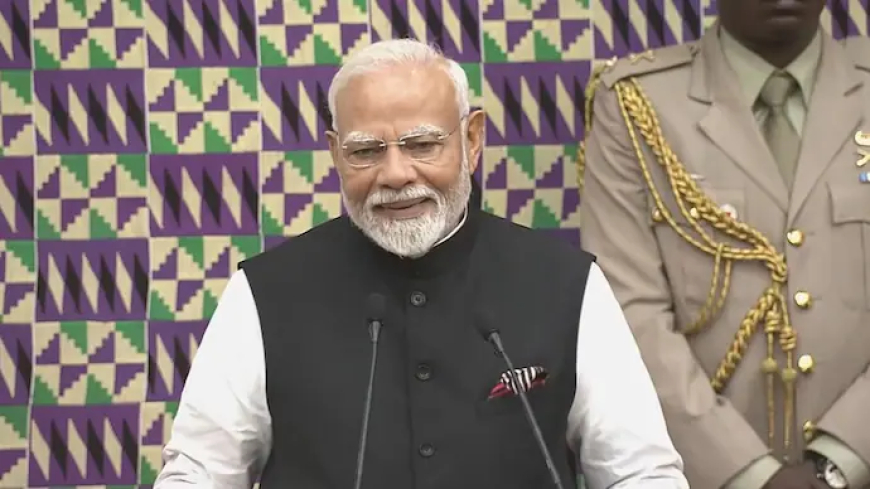
During a special address to Ghana’s Parliament, the Prime Minister of India showcased the extraordinary diversity of his nation, stating that India is home to over 2,500 registered political parties. He emphasized that this pluralism, alongside 22 official languages and thousands of dialects, forms the bedrock of India’s democracy and makes the country a welcoming and inclusive society.
By Joylinda Laryea / July 3rd, 2025
During a special address to Ghana’s Parliament, the Prime Minister of India showcased the extraordinary diversity of his nation, stating that India is home to over 2,500 registered political parties. He emphasized that this pluralism, alongside 22 official languages and thousands of dialects, forms the bedrock of India’s democracy and makes the country a welcoming and inclusive society.
“Our diversity is our greatest asset,” the Indian Prime Minister stated. “It is what makes India a welcoming and open society for people of all backgrounds, cultures, and religions.”
A History of India’s Political Landscape
India’s political history is as vibrant as its cultural heritage. Since gaining independence from British colonial rule in 1947, India adopted a multi-party democratic system. The Indian National Congress (INC), which led the struggle for independence under Mahatma Gandhi and Jawaharlal Nehru, became the first dominant political force in post-independence India.
In 1951, India held its first general elections, setting a global example as the world’s largest democratic exercise. Over the decades, new parties emerged to represent regional, linguistic, ethnic, and ideological interests. The rise of the Bharatiya Janata Party (BJP) in the 1980s and its consolidation of national power in the 2010s significantly reshaped India’s political balance.
Today, the political spectrum includes national parties like the BJP and INC, and numerous regional parties such as the All India Trinamool Congress (West Bengal), Dravida Munnetra Kazhagam (Tamil Nadu), and Aam Aadmi Party (Delhi), each addressing the unique concerns of their constituencies.
India’s Electoral Commission currently lists over 2,500 registered political parties, reflecting the country’s complex and dynamic democratic spirit.
The Prime Minister’s remarks in Parliament were part of a broader effort to deepen India-Ghana relations and promote cooperation in governance, technology, trade, and cultural exchange. His speech received a standing ovation from Members of Parliament and dignitaries present.
What's Your Reaction?
 Like
0
Like
0
 Dislike
0
Dislike
0
 Love
0
Love
0
 Funny
0
Funny
0
 Angry
0
Angry
0
 Sad
0
Sad
0
 Wow
0
Wow
0